
It is 2:00 PM. You have deadlines looming and a backlog of tasks to finish before 5:00.
You started the day strong, but right now, your brain feels like it is wading through mud. You can’t focus on the screen. Your eyes feel heavy. You reach for another coffee, hoping it will snap you out of it, but it doesn’t work.
You assume you are just tired. You assume it’s “afternoon burnout.”
You are wrong. You are suffocating.
The “Stuffy Room” Effect
If you work in a small room with the door closed—typical for editors, designers, and remote workers—you are creating a “CO2 Bubble.”
As you breathe, the Carbon Dioxide (CO2) levels in the room rise. Fresh air is around 400 ppm (parts per million). Once your room hits 1,000 ppm, cognitive function drops by 15%. At 1,400 ppm, it drops by 50%.
Most home offices hit 1,500 ppm by lunchtime without you realizing it.
The result? Brain fog. Mistakes in your work. That “heavy” feeling behind your eyes. You are literally trying to run a high-performance engine (your brain) without enough air intake.
The Solution: Make the Invisible, Visible
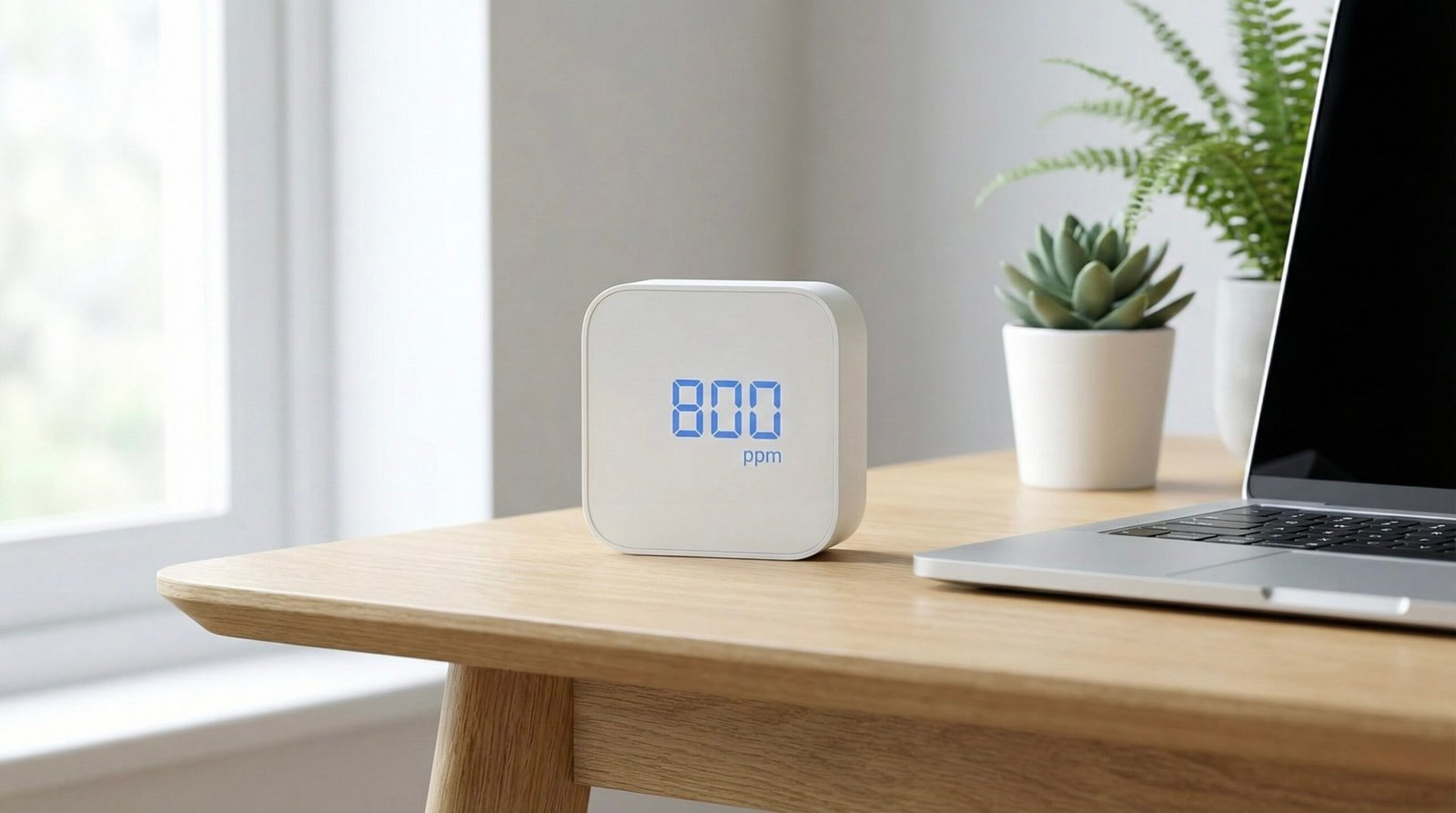
You can’t manage what you can’t measure. The only way to know if your air is killing your productivity is a CO2 Monitor.
This isn’t just a gadget; it is a bio-hack. It tells you exactly when to open a window or turn on a fan. It keeps you in the “Flow State” all day long.
Here are the best tools to keep your air—and your mind—clear.
1. The Gold Standard: Aranet4 Home
Best For: The “Buy It For Life” Professional.
If you watch tech YouTube or follow top productivity experts, you have seen this device. It is the undisputed king of air monitoring.
- Why it wins: It uses a genuine NDIR sensor (lab-grade accuracy). It has an E-Ink display (like a Kindle), so the battery lasts for years, not days. It shows CO2, Temperature, and Humidity.
- The Vibe: It looks like a sleek, scientific instrument. No glowing lights to distract you—just pure data.
- The Verdict: Expensive, but it is the investment serious professionals make.
2. The Smart Home Choice: Amazon Smart Air Quality Monitor
Best For: People who want “Set It and Forget It.”
If you don’t want to look at a screen, this device links to your Alexa ecosystem.
- Why it wins: It tracks 5 metrics (CO2, Dust, VOCs, Humidity, Temp). You can set it up so that if the air quality gets bad, your Echo dot speaks to you: “Air quality is poor, open a window.”
- The Vibe: Tiny, white, and invisible on your desk.
- The Verdict: The best budget-friendly option that integrates with your smart home.
3. The Visual Alarm: Qingping Air Monitor Lite
Best For: Designers and Aesthetes.
- Why it wins: It’s beautiful. It has a high-resolution OLED screen that supports touch gestures. A simple color bar (Green/Yellow/Red) lets you know the room status at a glance from across the room.
- The Vibe: Minimalist Apple-like design.
- The Verdict: A great middle-ground that looks amazing on a modern desk setup.
The “Fresh Air” Protocol
Once you have your monitor, here is the new routine to 10x your energy:
- The Baseline: keep your monitor visible on your desk.
- The Trigger: As soon as the number hits 1,000 ppm, stop working.
- The Reset: Open your door or window for exactly 5 minutes.
- The Result: Watch the number drop back to 450 ppm. You will physically feel the “brain fog” lift instantly.
Stop blaming yourself for being tired. Check your air.